
Troubleshooting CSV file imports
Overview
Users can use the spreadsheet (CSV) file data source to import customer and account data directly into their Ortto account’s Customer Data Platform (CDP). This guide covers common issues that might come up during the import and how to fix them.
NOTE: CSV files accepted (must use UTF-8 encoding). Max file size is 500MB.
Too many rows without merge keys
If you receive an error saying Too many rows without merge keys, this means that Ortto cannot find in the CSV file enough data matching your account’s unique identifiers to be able to create or update records in your CDP.
To be able to create meaningful CDP records, Ortto requires the following minimum fields:
- For people: First name, Last name, and Email address.
- For accounts: Name (of the account), as well as either the Email address or Phone number of the person being linked to this account.
By default, Ortto uses the following data values as unique identifiers:
- For people: their email address, followed by their phone number (as a fallback), and
- For accounts: its name.
You can modify the default identifiers under Settings > Customer data > Unique identifiers.
As such, the likely issue causing the error is that your CSV file is missing identifier data, e.g. people’s email addresses. When you’ve updated your CSV file to include the missing data, this should resolve the issue and allow you to complete the import.
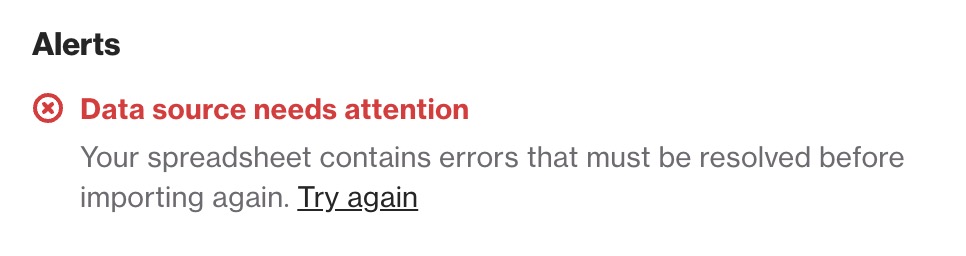
Data source needs attention
When there is an error during the import process and the file cannot be imported, the status will show Needs Attention in the data source's page, in the left-hand details panel.
The system will list any errors along with the rows and columns causing to the error. Learn more about common import errors.
Prior to re-importing, you'll need to resolve these errors within the spreadsheet first.
If an error occurs during the import process and the file cannot be imported, the data source status will display Needs Attention in the left-hand details panel on the data source page.
The system will identify any import errors and indicate the specific rows and columns where the issues were found. Learn more about common import errors.
Before attempting to re-import the file, you'll need to correct the identified errors in your spreadsheet.
Common import errors
Errors within the spreadsheet can impact what data is imported, or whether the file is imported at all.
Invalid email
When importing email values, ensure that all rows contain valid email addresses in the correct format.
An example of an invalid email address is: johndoe@email.com[work].

Invalid date
When importing date values, ensure that all dates and times match the date and time format configured in your account's General Settings.
For example, if your account is configured to use MM/DD/YYYY (12-hour format), but the spreadsheet contains dates in DD/MM/YYYY (24-hour format), the values will be considered invalid and may cause import errors.
